Cook County divorce
Cook County Divorce Lawyer
A Cook County divorce lawyer can help with filing, financial issues, parenting arrangements and court proceedings. Chicago Family Attorneys LLC focuses only on family law and offers free initial consultations for people seeking to hire an attorney.
Initial consultations are free for people seeking to hire an attorney. Your fee is confirmed in writing before you engage the firm.

Your next step
Book a Free Consultation
Looking to hire an attorney? Answer the required questions and choose a consultation. The calendar opens after the required answers confirm your scheduling readiness. Your answers stay on this page and are not saved or sent with the booking.
Initial consultations are free for people seeking to hire an attorney. Representation fees and the scope of work are confirmed separately.
The initial consultation is free for people considering hiring an attorney. This question asks whether you need the legal work itself to be free.
This concerns paid representation, not a charge for the free initial consultation. The fee depends on the work and is confirmed in writing. Choose a timing category only; do not provide amounts, account information or case details.
These programs set their own eligibility and availability. Contact the provider to find out whether it can help.
Calendly connects to the firm’s live schedule. Completing its booking form creates a real appointment. Save confidential details for private intake.
Choose the help you need and answer the required questions.
Booking does not establish an attorney-client relationship. Acceptance and engagement terms are confirmed separately.
Getting help with a divorce
You may be preparing to file, responding to a spouse's petition or trying to understand an existing case. Start by identifying the issues that need attention: parenting, support, maintenance, property or the terms of a proposed agreement. A consultation is a place to discuss those concerns and the scope of legal help you are seeking.
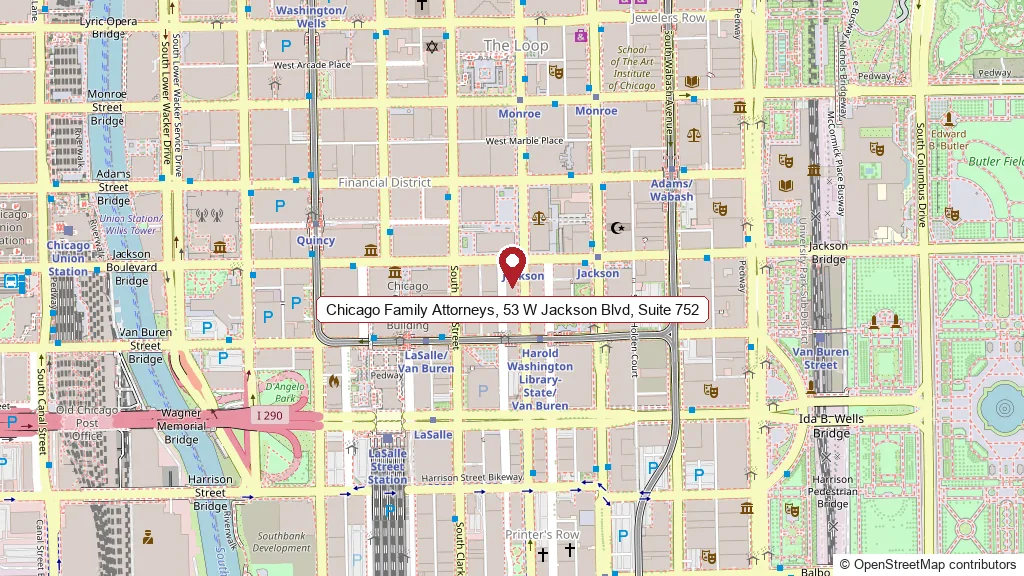
At Chicago Family Attorneys LLC, we focus only on family law. Managing attorney Aaron Korson has been licensed in Illinois since 2019. Our office is at 53 W Jackson Blvd, Suite 752, Chicago, IL 60604. We serve Cook, DuPage, Lake and Will counties.
Our Chicago divorce attorneys can discuss full representation or a defined task through limited-scope representation. The written agreement identifies the covered work. No lawyer can promise a particular result, and outcomes depend on the facts.
A Cook County divorce attorney from the firm can handle the whole case or a defined part of it; the representation options and published fees are below.
Where can you file for divorce?
County venue and Illinois residency are separate questions. Under 750 ILCS 5/104, proceedings take place in the county where the plaintiff or defendant resides. Process may be directed to any county in Illinois. A Cook County connection should be reviewed before choosing where to file.
Under 750 ILCS 5/401(a), one spouse must have been an Illinois resident, or stationed here in the armed services, when the case began. That residence or presence must have been maintained for 90 days before commencement or the court's finding.
The statute also requires irreconcilable differences that caused the marriage's irretrievable breakdown. Reconciliation efforts must have failed, or future attempts must be impracticable and not in the family's best interests.
Under 750 ILCS 5/401(a-5), if the spouses have lived separate and apart for a continuous period of not less than 6 months immediately before entry of the judgment, there is an irrebuttable presumption that the irreconcilable differences requirement is met. This means the court treats that requirement as established.
Do not choose a courthouse based only on proximity. Assignment and location depend on the case and filing. If DuPage County may be relevant, review our DuPage courthouse and remote hearing information and discuss venue during your consultation.
Courthouse locations
The Domestic Relations Division hears divorce, maintenance, property division, child support, allocation of parental responsibilities and parenting time. It also hears enforcement and modification matters involving prior judgments. Its main location is the Richard J. Daley Center in Chicago.
| Location | Address |
|---|---|
| Richard J. Daley Center | 50 W. Washington St., Chicago, IL 60602 |
| Skokie Courthouse | 5600 Old Orchard Road, Skokie, IL 60077 |
| Rolling Meadows Courthouse | 2121 Euclid Avenue, Rolling Meadows, IL 60008 |
| Maywood Courthouse | 1500 Maybrook Drive, Maywood, IL 60153 |
| Bridgeview Courthouse | 10220 S. 76th Avenue, Bridgeview, IL 60455 |
| Markham Courthouse | 16501 S. Kedzie Parkway, Markham, IL 60428 |
Cook County has six municipal districts. This list does not determine where your case belongs. Confirm the assigned location with the Clerk and the court's official site rather than assuming that a particular suburb must use a particular courthouse.
Families in Evanston, Skokie, Glenview and Northbrook can read our North Shore divorce and family lawyer page.
The Clerk's Daley Center office is in Room 802 and can be reached at (312) 603-6441. Daley Center hours are Monday to Friday, 8 a.m. to 6 p.m. Those building hours do not replace your assigned hearing time.
Cook County divorce courthouses and the towns they serve
Cook County divorce cases are heard in the Circuit Court's Domestic Relations Division. The table lists some of the towns in each suburban district. Do not assume that your suburb determines the courthouse. Confirm the assigned location with the Clerk and the court's official site.
| District and courthouse | Some of the towns it serves |
|---|---|
| Second District, Skokie | Evanston, Skokie, Wilmette, Winnetka, Glenview and Northbrook belong to the Cook County court's Second Municipal District, which sits at the Skokie Courthouse, 5600 Old Orchard Road. |
| Third District, Rolling Meadows | Arlington Heights, Mount Prospect, Palatine, Rolling Meadows and the Cook County part of Schaumburg belong to the Cook County court's Third Municipal District, which sits at the Rolling Meadows Courthouse, 2121 Euclid Avenue. |
| Fourth District, Maywood | Oak Park, River Forest, Berwyn, Cicero, Forest Park and Elmwood Park belong to the Cook County court's Fourth Municipal District, which sits at the Maywood Courthouse, 1500 Maybrook Drive. |
| Fifth and Sixth Districts, Bridgeview and Markham | Oak Lawn and the Cook County parts of Orland Park and Tinley Park belong to the court's Fifth Municipal District at the Bridgeview Courthouse; Homewood, Chicago Heights and Calumet City belong to the Sixth, at Markham. |
For local detail, see the Evanston and Skokie divorce lawyer, Schaumburg and Arlington Heights divorce lawyer, Oak Park and west suburbs divorce lawyer and Orland Park and south suburbs divorce lawyer pages.
How to file for divorce in Cook County
The following steps describe the main issues in a Cook County divorce. They are a general guide, not a filing checklist for every case. Our Illinois divorce stages guide and family law case process guide provide related information.
- Review venue and residency. Determine whether Cook County is an appropriate county under 750 ILCS 5/104 and review the residency requirements in 750 ILCS 5/401.
- Prepare the verified petition. Under 750 ILCS 5/403, it includes information such as each spouse's age, occupation and residence, marriage details, children's names, ages and addresses, arrangements concerning support and parental responsibilities, and the relief requested.
- File electronically unless an exemption applies. Review filing and service questions with a lawyer. Cook County provides e-filing assistance, but technical help does not replace a review of the legal issues.
- Confirm the assignment and hearing information. New cases are randomly assigned to an individual calendar judge or a judicial team. Check the assigned calendar, location and any posted standing orders.
- Address temporary needs and parenting issues. Either party may request temporary maintenance or child support under 750 ILCS 5/501. Parenting plans and mediation may also need attention while the case is pending.
- Address the terms of the divorce. These may include property, maintenance, child support and parental responsibilities. Spouses may make written agreements under 750 ILCS 5/502, subject to the statute's requirements.
- Proceed toward judgment. Under 750 ILCS 5/401(b), the court must consider, approve, reserve or make provision for allocation of parental responsibilities, child support, maintenance and property before entering the divorce judgment. Issues may be reserved by agreement or on motion with a court finding.
Filing a petition does not establish a fixed completion date. Disputed issues and the facts of the case affect the proceedings.
Case assignment and hearings
An individual calendar judge handles a case from the beginning through post-decree matters. A judicial team divides responsibilities: a preliminary judge hears pretrial matters, while trial judges hear contested trials, prove-ups and post-decree matters. Some judges have standing orders posted on the court's site.
The Domestic Relations Division is subject to Part 13 of the Rules of the Circuit Court of Cook County. The court's rules control the exchange of financial information in a Cook County case. Relevant local provisions include 13.3.1 Mandatory Disclosure, 13.3.2 Proof of Income and 13.4 Pre-Trial Phase. Discuss the requirements that apply to your case rather than relying on a general document list alone.
Filings must be electronic, with listed exemptions. E-filing help is available at eFilehelp@cookcountycourt.com or 312-603-5030. If your assigned court has posted remote appearance instructions, our Cook County Domestic Relations remote hearing guide may help, but always confirm the current instructions for your assigned court on the court's official site.
Under 750 ILCS 5/413, judgment is to be entered within 60 days after the closing of proofs, or 90 days if the court enters an order specifying good cause. This is not a deadline measured from filing. The judgment is final when entered, subject to appeal.
Cook County domestic relations Zoom links and calendars
The Circuit Court of Cook County tells people to get their Zoom ID and passcode from the Clerk's Office. Check your latest order before each court date, and see our Cook County domestic relations Zoom links page.
Do you have to go to court for a divorce in Cook County?
Usually yes, at least once. When spouses have agreed on every issue, the judge typically finalizes the divorce at a prove-up hearing, as the court's Domestic Relations FAQ explains. In a default case, the judge hears the petitioner's testimony in open court before entering judgment (750 ILCS 5/405), and in a joint simplified dissolution the statute requires both spouses to appear in person before the court (750 ILCS 5/453).
Under Illinois Supreme Court Rule 45, a remote appearance that the court allows counts the same as an in-person appearance. The Domestic Relations Division posts Zoom and contact information for remote court proceedings. Whether your hearing is at the courthouse or by Zoom depends on your courtroom, so check our Cook County Domestic Relations Zoom page and follow the instructions in your latest order.
How long does a divorce take in Cook County?
There is no fixed timeline. An agreed case can move to judgment once the paperwork, any parenting plan and the financial terms are complete; a contested case takes longer because each disputed issue may need discovery, mediation or a trial.
A few dates are set by statute. Parents must file a proposed parenting plan within 120 days after service or filing of a petition for allocation of parental responsibilities, unless the court extends the time for good cause (750 ILCS 5/602.10(a)), and the court orders mediation of parenting issues unless it finds impediments to mediation (750 ILCS 5/602.10(c)). If the spouses have lived separate and apart for a continuous period of at least 6 months immediately before judgment, there is an irrebuttable presumption that the irreconcilable differences requirement is met (750 ILCS 5/401(a-5)).
Parenting plans and mediation
Under 750 ILCS 5/602.10(a), all parents must file a proposed parenting plan within 120 days after service or filing of a petition for allocation of parental responsibilities. The court may extend that deadline for good cause. Under 750 ILCS 5/602.10(c), the court shall order mediation to help the parents formulate, modify or implement a parenting plan unless impediments to mediation exist.
Under Cook County's mediation program, mediation is mandatory for initial allocation of parental responsibilities, modification of allocation, relocation and non-parent visitation. Mediation is discretionary for other issues, including financial and discovery disputes. The court may order discretionary mediation even if a party objects.
When parties cannot agree on a mediator for child-related issues, Family Court Services conducts mediation. Parties may agree to a private mediator. The court may refer financial mediation to a court-certified mediator who is an attorney.
Family Court Services is at 69 W. Washington St., Suite 1000, Chicago, and its phone number is (312) 603-1540. It also provides parent education, emergency intervention, home studies, evaluations and the Children and Teens Speak program.
Our Chicago divorce mediation attorneys can discuss mediation in the context of your case. Bring any existing parenting orders and proposed arrangements to your consultation.
Support, property and agreements during divorce
Temporary financial needs and final divorce terms are different questions. Under 750 ILCS 5/501, a request for temporary maintenance or child support includes a financial affidavit supported by documents such as tax returns, pay stubs and bank statements.
Under 750 ILCS 5/502, spouses may agree in writing about property, maintenance, support and parental responsibilities. Terms other than children's support and parental responsibilities bind the court unless it finds the agreement unconscionable. The court decides parenting issues according to the child's best interests under 750 ILCS 5/602.5 and 750 ILCS 5/602.7. An agreed parenting plan binds the court unless the court finds it is not in the child's best interests (750 ILCS 5/602.10(d)). An agreement should be reviewed in light of the specific facts, not treated as interchangeable with another family's settlement.
Cook County divorce lawyer fees and representation options
Limited-scope representation is a flat fee for a defined task, quoted after a consultation and usually paid up front, though in some cases in two installments.
Full representation starts with an initial payment of $1,500 to $2,500, followed by $500 to $650 per month beginning 30 days after the initial payment while representation remains active. It covers drafting, hearings, motions and phone calls within the agreed scope.
An attorney-handled uncontested divorce is a $1,500 flat fee (court filing fees not included).
Enforcement of a court order: an individually quoted upfront amount plus $350 per hour.
Court filing costs, expert fees, service costs and evaluation costs are separate. The client pays them and the firm does not advance them. The written agreement confirms the fee, covered work and expenses before engagement. Fee ranges shown are not a quote for your matter. Call 312-965-5618 for a quote.
- Review the family law pricing overview.
- Review the covered work on our contested divorce fee page and uncontested divorce fee page.
- Read about limited-scope representation fees.
- For an existing order, review court order enforcement fees.
What to bring to a consultation
Bring the information you have so the consultation can focus on your concerns and the legal work you are seeking. This is a discussion list, not a statement of everything the court requires.
- Any filed petition, existing judgment, court orders and hearing information.
- Marriage details and each spouse's residence information.
- Children's names, ages, addresses and current parenting arrangements.
- Available tax returns, pay stubs and bank statements.
- Information about property and any written agreements.
- Questions about disputed issues, representation scope and fees.
If you already have a case, include the assigned calendar and courthouse information. If you are considering filing, explain your county connections and the issues you expect the divorce to address.
Book a free consultation. Initial consultations are free for people seeking to hire an attorney. Call 312-965-5618 to discuss a Cook County divorce matter with Chicago Family Attorneys LLC.
Which Cook County courthouse serves Des Plaines, Wheeling and Buffalo Grove
The Circuit Court of Cook County lists these municipalities in its Second Municipal District, which sits in Skokie: Deerfield (the Cook County part only), Des Plaines, Evanston, Glencoe, Glenview, Golf, Kenilworth, Lincolnwood, Morton Grove, Niles, Northbrook, Northfield, Park Ridge, Skokie, Wilmette and Winnetka. The Circuit Court of Cook County lists these municipalities in its Third Municipal District, which sits in Rolling Meadows: Arlington Heights, Barrington, Barrington Hills, Bartlett, Bensenville, Buffalo Grove, East Dundee, Elgin, Elk Grove Village, Hanover Park, Harwood Heights, Hoffman Estates, Inverness, Mount Prospect, Norridge, Palatine, Prospect Heights, Rolling Meadows, Roselle, Rosemont, Schaumburg, Schiller Park, South Barrington, Streamwood and Wheeling. For Barrington, Barrington Hills, Bartlett, Bensenville, Buffalo Grove, East Dundee, Elgin, Elk Grove Village, Hanover Park, Hoffman Estates, Roselle and Schaumburg, the court marks its jurisdiction as limited to the part of the town inside Cook County.
Property, business, high-asset, parentage and same-sex couple questions in a Cook County divorce
Property division, business valuation and high-asset finances
A property division lawyer in Chicago can help review assets, debts, disputed ownership and settlement proposals. A divorce lawyer for business owners in Chicago can help address ownership, financial records, valuation questions and operational continuity. See the high asset divorce lawyer page.
Paternity, prenuptial and postnuptial agreements
A Chicago paternity lawyer can review whether parentage is already established, explain options for a disputed acknowledgment and pursue parenting or support orders within the agreed scope. See prenuptial agreements and postnuptial agreements.
Same-sex couples
An LGBTQ family law attorney in Chicago can help with parentage, adoption, parenting arrangements and separation.
Who handles your Cook County divorce
Aaron Korson, attorney and founder of Chicago Family Attorneys, handles divorce, parenting disputes and other family law matters. Managing attorney Aaron Korson has been licensed in Illinois since 2019 and earned his Juris Doctor from Western Michigan University Cooley Law School.
Read the law and court pages
Checked against the official sites on October 14, 2026. Laws change; confirm the current text before relying on it.
- Cook County Domestic Relations Division
- Cook County mediation program for Domestic Relations cases
- Cook County Family Court Services
- Cook County information about Domestic Relations cases
- 750 ILCS 5/104: Venue
- 750 ILCS 5/401: Dissolution requirements
- 750 ILCS 5/403: Petition and proceedings
- 750 ILCS 5/413: Judgment
- 750 ILCS 5/501: Temporary relief
- 750 ILCS 5/502: Agreements
- 750 ILCS 5/602.5: Allocation of decision-making responsibilities
- 750 ILCS 5/602.7: Allocation of parenting time
- 750 ILCS 5/602.10: Parenting plans and mediation
- Clerk of the Circuit Court of Cook County
- Richard J. Daley Center location and hours
Talk with a family law attorney
Bring your questions and the documents you have. The initial consultation is free for people seeking to hire an attorney, and the firm confirms its fee and the covered work in writing before you engage it. Call 312-965-5618 or book online.
Featured guides
All divorce articles- Divorce
How to File for Divorce in Cook County: A Step-by-Step Guide
A step-by-step guide to filing for divorce in Cook County: residency, the right courthouse, required forms, eFileIL e-filing, fee waivers, service and your first court dates. - Illinois family law guides
Cook County Domestic Relations Division: A Practical Guide
A plain-language guide to the Cook County Domestic Relations Division: where family cases are heard, how calendars are assigned, what pre-decree and post-decree mean, and where self-represented parents can find help. - Divorce
How to Serve Divorce Papers in Illinois
How Illinois divorce papers are served: the 30-day summons, the sheriff, private and special process servers, a spouse's appearance, out-of-state service, publication when a spouse cannot be found and proof of service.


Common questions
Frequently asked questions
General information, not legal advice for your situation.
Which courthouse will handle my divorce?
Assignment and location depend on the case and filing. The Domestic Relations Division's main location is the Richard J. Daley Center, and Cook County also has suburban courthouse locations. Do not assume that your suburb determines the courthouse. Confirm the assigned location with the Clerk and the court's official site.
Do I have to file electronically?
Cook County requires electronic filing unless a listed exemption applies. For technical filing help, contact eFilehelp@cookcountycourt.com or 312-603-5030. Technical assistance does not replace legal review of your petition or service questions. Our family law case process guide provides related information for discussing your filing needs with a lawyer.
How long does a divorce take?
There is no fixed overall divorce length set by statute, and the judgment deadline in 750 ILCS 5/413 runs from the closing of proofs, not filing. Review our Illinois divorce stages guide for context on the proceedings rather than treating that deadline as a total case timeline.
Is mediation required?
Under Cook County's mediation program, mediation is mandatory for initial allocation of parental responsibilities, modification of allocation, relocation and non-parent visitation. Under 750 ILCS 5/602.10(c), the court shall order mediation to help the parents formulate, modify or implement a parenting plan unless impediments to mediation exist. Mediation is discretionary for other issues, including financial and discovery disputes, and the court may order discretionary mediation even if a party objects. Discuss any concerns about participating with a lawyer rather than assuming the same process applies to every dispute.
When is a proposed parenting plan due?
Under 750 ILCS 5/602.10, the deadline is 120 days after service or filing of a petition for allocation of parental responsibilities. The court may extend it for good cause. Bring the petition and service information to your consultation so the deadline can be reviewed against your case's filings.
Can I hire a lawyer for only part of my case?
Yes. Limited-scope representation covers a defined task identified in the written agreement. Discuss the work you are seeking during a consultation so the proposed scope can be reviewed. See the fees section above and our limited-scope family law fee page for information about this representation option.
Do you have to go to court for a divorce in Cook County?
Usually yes, at least once. When spouses have agreed on every issue, the judge typically finalizes the divorce at a prove-up hearing. In a default case, the judge hears the petitioner's testimony in open court (750 ILCS 5/405), and in a joint simplified dissolution both spouses must appear in person before the court (750 ILCS 5/453). Under Illinois Supreme Court Rule 45, a remote appearance that the court allows counts the same as appearing in person, so check your latest order and your courtroom's instructions to see whether you go to the courthouse or appear by Zoom.
Do you handle divorce cases at the suburban Cook County courthouses?
Chicago Family Attorneys LLC handles these cases in Cook County family court, at the Daley Center and the suburban courthouses, and in DuPage, Will and Lake Counties, in English and Spanish.
Where do I file for divorce in Cook County?
Cook County divorce cases are heard in the Circuit Court's Domestic Relations Division. Filing generally must be electronic, with listed exemptions. Cook County also has courthouse locations in Skokie, Rolling Meadows, Maywood, Bridgeview and Markham.
Which Cook County courthouse serves Oak Park, Berwyn and Cicero?
It may be the Maywood Courthouse. Oak Park, River Forest, Berwyn, Cicero, Forest Park and Elmwood Park belong to the Cook County court's Fourth Municipal District, which sits at the Maywood Courthouse, 1500 Maybrook Drive. Cases are also heard at the Daley Center, so check your summons or ask the Clerk.